

How Can Local Businesses Encourage More Reviews on Google?
Key Takeaway
- Getting more reviews on Google almost never comes down to weak service. It comes down to simply not asking or asking at the wrong moment.
- The vast majority of customers are open to leaving a review. Very few actually do it without being asked.
- Making it effortless, a QR code or a direct link matters as much as the ask itself.
- Offering a reward for a positive review breaks Google’s rules and can carry real regulatory risk. Asking every customer for honest feedback doesn’t.
- The businesses with the most reviews usually aren’t the ones with the best service. They’re the ones with the best habit of asking.
Introduction
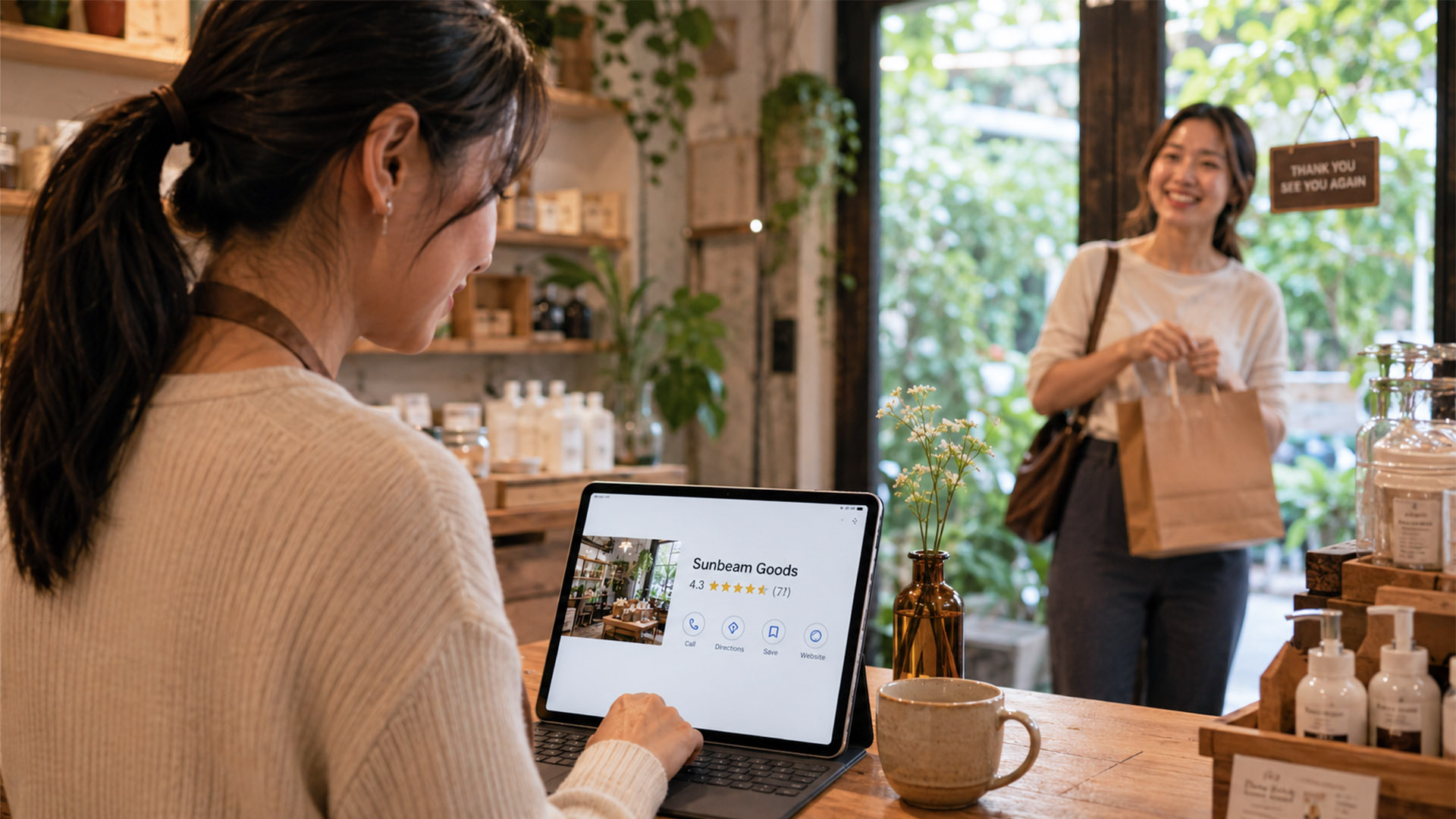
A shop with genuinely great service and only twelve Google reviews after two years in business isn’t unusual. It’s actually the default outcome for most local businesses, and it has almost nothing to do with the quality of the experience customers are having. It has everything to do with what happens, or doesn’t happen, in the thirty seconds after a customer walks out satisfied.
This guide is about that gap specifically: why customers who’d happily leave a good review usually don’t, and what actually closes that gap. If you’re already generating a healthy number of reviews and the challenge has shifted to keeping up with responding to them, our companion guide on managing Google reviews efficiently covers that side instead.
Why Most Happy Customers Never Leave a Review
It’s tempting to assume customers who don’t leave a review simply weren’t impressed enough. The data says otherwise. According to BrightLocal’s 2026 Local Consumer Review Survey, 94% of consumers are open to writing a review, yet only 69% actually wrote one in the past year. The gap between “willing” and “did it” isn’t about satisfaction. It’s about friction and forgetting.
A customer leaves a shop happy, gets in the car, and by the time they’re home, a dozen other things have taken over their attention. The review they were genuinely willing to write never happens, not because they changed their mind but because nothing prompted them to act while the experience was still front of mind.
When Should You Ask Customers for a Google Review?
The single biggest lever a business has is remarkably simple: ask. The same BrightLocal research found that 83% of consumers who were asked to leave a review went on to write one. That’s a dramatically higher conversion rate than hoping a satisfied customer thinks to do it on their own.
Timing matters as much as the ask itself. The best moment is immediately after a positive interaction, at the counter, right after a service is completed, while the experience is still fresh, not three days later through a generic email blast the customer barely remembers opening. The longer the gap between the experience and the ask, the weaker the response.
How Can You Make It Easier for Customers to Leave a Google Review?
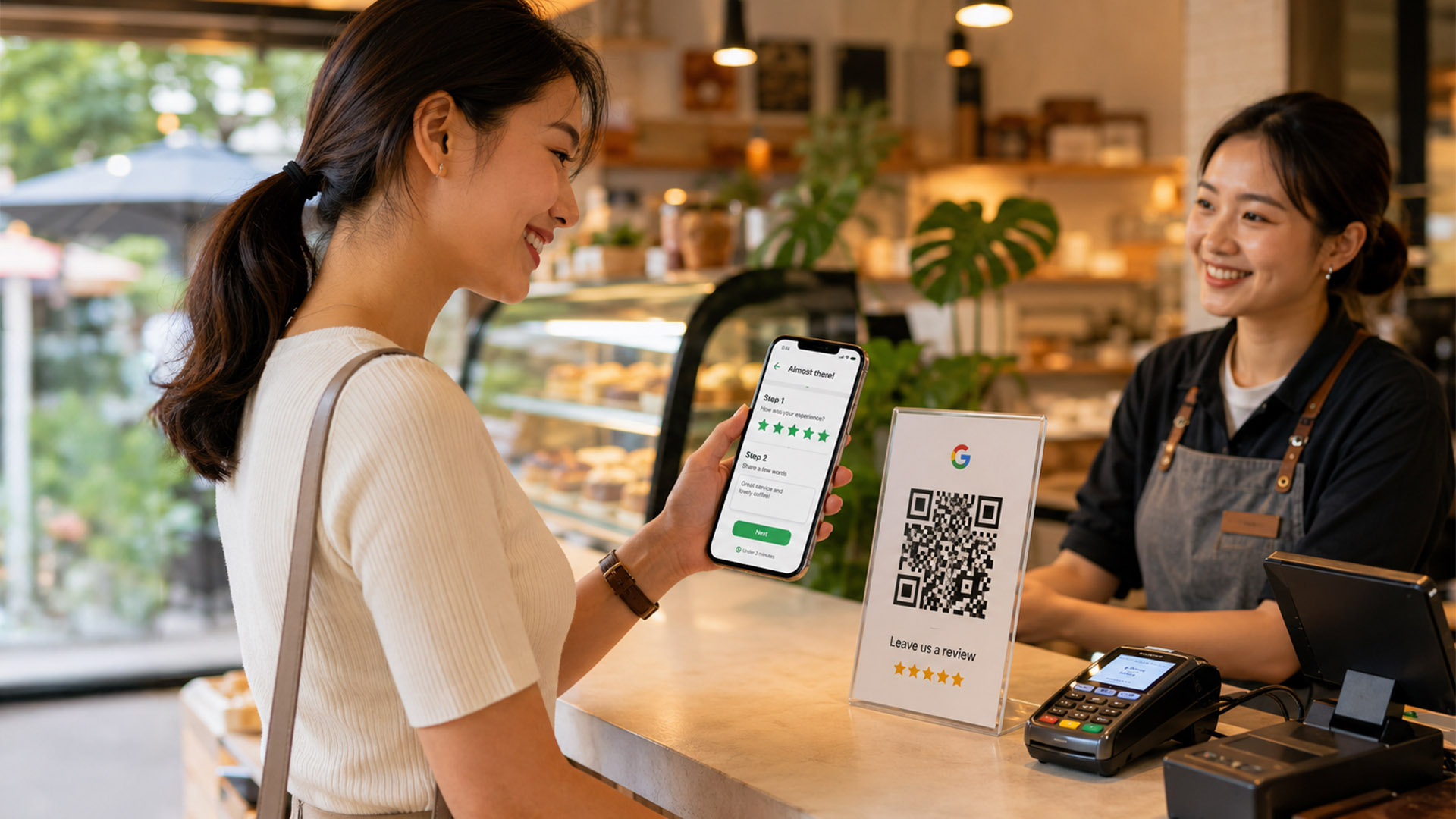
Willingness alone doesn’t survive friction. If leaving a review means opening an app, searching for the business by name, and navigating through several screens, a meaningful share of otherwise willing customers will simply give up partway through. Every extra step between “I’d like to leave a review” and actually posting one costs a percentage of customers who intended to follow through.
Removing that friction is often as simple as a QR code at the counter or a direct link sent right after the purchase, one that takes the customer straight to the review prompt instead of a general search. Tools built specifically for this, like Synqro’s Auto Google Reviews, work through exactly this kind of QR flow, guiding the customer through two quick prompts so leaving a review takes under two minutes rather than requiring them to find the business profile themselves.
It’s worth testing where the QR code actually sits, too. A code buried on a printed receipt gets noticed far less often than one placed where a customer is already looking, like at the point of payment or on a table tent near where they’re seated. Small placement choices like this noticeably change how many customers actually follow through.
What Are Google’s Rules for Asking Customers for Reviews?
This part gets skipped by a lot of advice online, and it matters. Google explicitly prohibits offering a reward, discount, or incentive in exchange for a review, and conditioning that reward specifically on a positive review carries real regulatory risk under recent consumer protection rules in several markets. Reviews obtained this way can also be removed by Google if detected, undoing the effort entirely.
The safe, compliant approach is to ask every customer for honest feedback, regardless of what they’re likely to say, rather than offering something only to customers who leave five stars. Interestingly, BrightLocal’s research notes that businesses have been pulling back from discount-based incentives over the past two years, likely for exactly this reason. Ask consistently and honestly. It works, and it doesn’t put the business at risk.
Who Should Ask Customers for Google Reviews?
Software helps remove friction, but the ask itself often works best coming from a person, not just a QR code sitting quietly on the counter. Staff who are trained to mention it verbally, “we’d really appreciate a quick review if you have a moment,” tend to see better response rates than a passive sign alone. The two work well together: a staff member prompts the customer, and the QR code or link makes following through effortless immediately afterward.
This doesn’t need to be a scripted, awkward moment. A brief, genuine mention at the point of payment or when saying goodbye is usually enough, especially when it’s backed by a fast, frictionless way to actually do it.
What Is the Best Way to Get More Google Reviews?
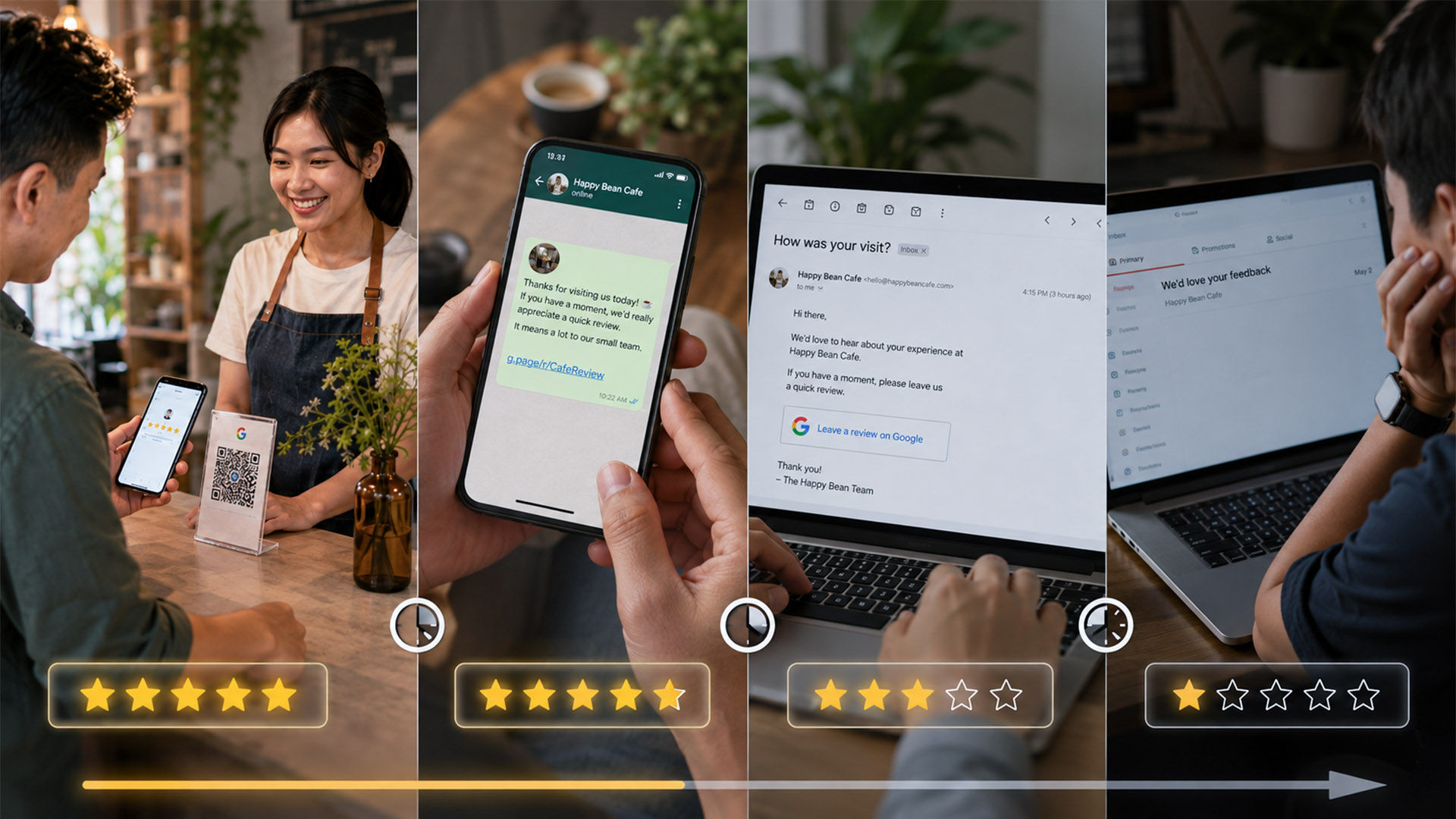
Not every method works equally well. Based on how quickly a request reaches the customer and how much friction stands between the ask and the actual review, a rough ranking looks like this:
In-person requests with an immediate QR code or link tend to perform best, since the ask happens at the peak of a positive experience and the action takes under a minute. SMS or WhatsApp follow-ups sent within an hour of the visit perform nearly as well, particularly for service-based businesses where the customer isn’t still standing at the counter, such as a home repair visit or a delivery. Email requests sent the same day perform reasonably, though noticeably worse than SMS or WhatsApp due to lower open rates on marketing-adjacent emails. Generic email blasts sent days or weeks later perform worst of all, often getting ignored entirely by customers who no longer clearly remember the visit, or filtered straight into a promotions folder before it’s ever opened.
The pattern across all four is consistent: effectiveness drops sharply the further the request sits from the actual moment of a good experience. A business choosing between building one strong in-person habit and running an occasional email campaign will almost always see better results from the former, even though the email campaign feels more like a “proper” marketing effort.
What Should You Do If You Get a Negative Google Review?
Asking more customers for reviews naturally means receiving more feedback, including the occasional negative review. That’s not necessarily a problem. In fact, a steady flow of honest reviews will usually include both positive and negative experiences.
Don’t stop asking for reviews because you’re worried about negative feedback. Asking only customers who appear happy can create a biased review profile and may conflict with Google’s expectations around genuine feedback. A better approach is to ask customers consistently and give everyone the same opportunity to share their experience.
When a negative review does appear, avoid responding defensively or trying to prove the customer wrong. Acknowledge the experience, keep the response professional, and move the detailed conversation into a private channel where your team can understand what happened and try to resolve it.
A simple response might be:
“We’re sorry to hear that your experience didn’t meet expectations. We’d like to understand what happened and see how we can make this right. Please contact us directly so our team can look into it.”
A thoughtful response also shows potential customers reading your reviews that the business takes feedback seriously.
There is another benefit to actively asking for reviews: negative feedback can reveal problems before they become recurring issues. If several customers mention the same problem, whether it’s long waiting times, poor communication, delivery delays, or an unclear policy, you have something concrete to investigate and improve.
The goal of a review strategy isn’t to create a perfect five-star profile. It’s to create a consistent flow of genuine feedback, learn from it, respond appropriately, and improve the customer experience over time.
For a deeper look at responding to and managing reviews after they arrive, see our guide on managing Google reviews efficiently.
How Can a Local Business Get More Google Reviews?
Getting more Google reviews doesn’t require complicated campaigns or constant promotions. For most local businesses, the biggest improvement comes from turning review requests into a simple, repeatable part of the customer journey.
A practical process looks like this:
- Deliver a good customer experience.
Reviews start with the experience itself. Make sure customers receive the service, product, or support they expected. - Ask at the right moment.
The best time to ask is usually shortly after a positive interaction, while the experience is still fresh. For a salon, that might be after the appointment. For a restaurant, it could be after the meal. For a retailer, it might be immediately after purchase. - Make the review easy to leave.
Don’t ask customers to search for your business on Google themselves. Give them a direct review link or QR code that takes them straight to the relevant review page. - Ask consistently.
Don’t rely on individual employees remembering to ask. Build the request into your regular process so customers receive the same opportunity to leave feedback after relevant interactions. - Keep the request genuine.
Ask for an honest review rather than asking specifically for five stars. Don’t offer discounts, gifts, or other incentives in exchange for positive reviews. - Respond to the reviews you receive.
Thank customers for positive feedback and respond professionally to negative reviews. This shows that your business is listening and gives future customers another reason to trust you.
The businesses that consistently generate reviews aren’t necessarily asking customers to do something extraordinary. They’re simply asking at the right time, removing friction, and making the request part of their everyday customer experience.
If your team doesn’t have the time to manually ask every customer, an automated review workflow can help build that habit into the customer journey. Synqro’s Auto Google Reviews helps businesses send review requests through QR codes and automated follow-ups, making it easier to consistently ask customers for honest feedback.
Frequently Asked Questions

How many reviews should a local business aim for?
There’s no fixed number, but consistency matters more than a target. Businesses that ask regularly tend to build a steady stream of recent reviews, which matters to customers more than a large but stale total.
Is it against Google’s rules to ask for a review?
No. Asking customers for honest feedback is completely acceptable and encouraged. What’s against the rules is offering a reward or incentive specifically for a positive review.
What’s the best way to ask for a review without sounding pushy?
A brief, genuine mention at the point of purchase, followed immediately by an easy way to actually do it, like a QR code, tends to feel natural rather than pushy, especially compared to a follow-up email days later.
Do QR codes for reviews actually work?
Yes, largely because they remove the friction of searching for the business online. A customer who’s already willing to leave a review is far more likely to follow through when the process takes under a minute.
What if a customer refuses or ignores the request?
That’s expected and fine. Not every customer will leave a review even when asked, but asking consistently still produces a significantly higher response rate than not asking at all.
Should every customer be asked, or only the happiest ones?
Every customer, without filtering by how the interaction seemed to go. Asking only customers who appear happiest can look like selectively soliciting positive reviews, which sits closer to the practices Google’s guidelines discourage. Honest, consistent asking is both safer and, per the data above, still weighted toward positive outcomes since most customers genuinely are satisfied most of the time.
Getting more reviews on Google was never really about convincing reluctant customers. Most of them are already willing. It’s about asking at the right moment, making the process effortless, and doing it consistently rather than occasionally. The businesses with strong review counts didn’t necessarily earn dramatically better feedback than their competitors. They just built a habit of asking that most businesses never get around to. If manually asking every customer and hoping they follow through feels inconsistent, Synqro’s Auto Google Reviews tool builds that habit into the checkout moment automatically. And once reviews start coming in more regularly, our guide on managing Google reviews efficiently will help you keep up with them.

