

AI Automation vs AI Agents: Key Differences and Use Cases
Key Takeaway
- AI automation vs AI agents comes down to one question: does the system follow a fixed set of steps, or does it figure out its own steps to reach a goal?
- Automation is a recipe. An agent is a chef. One executes instructions precisely. The other decides what to do based on what’s in front of it.
- Automation is the right choice for repetitive, predictable tasks. Agents are the right choice for tasks that involve judgement, conversation, or unpredictable situations.
- Most real businesses need both, not one or the other. They usually just don’t realise it yet.
- The tools worth trusting are the ones that are honest about which of the two they actually are.
Introduction
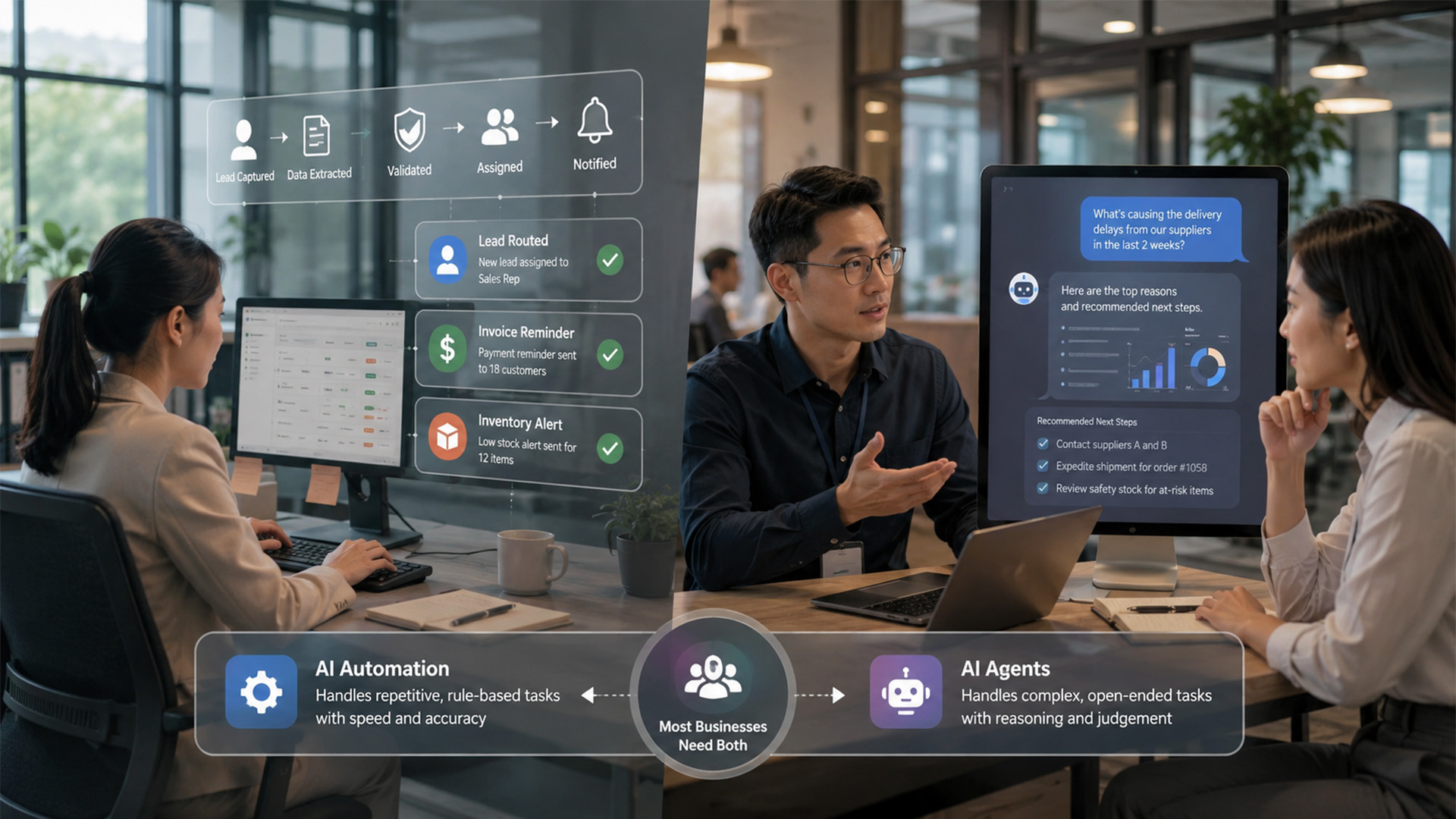
If you’ve spent any time reading about AI lately, you’ve probably seen the terms “AI automation” and “AI agents” used almost interchangeably. Marketing pages blur them together on purpose because “agent” sounds more impressive than “automation”. That’s a problem because they’re not the same thing, and picking the wrong one for a task can waste months and a real budget.
The good news is that the actual difference isn’t complicated once someone explains it without the jargon. This guide does exactly that, with plain-language definitions, an original diagram to make the difference visually obvious, real business examples, and a simple way to decide which one a given task actually needs.
AI Automation vs AI Agents: Definitions
What Is AI Automation?
AI automation follows a fixed set of steps you’ve already decided on.
Think of AI automation like a recipe card taped to the wall in a busy kitchen. It tells you exactly what to do, in exactly what order, every single time. Add the flour, then the eggs, then the milk. If an ingredient is different today, the recipe doesn’t adjust on its own. Someone has to notice and step in.
That’s how AI automation works. It follows predefined rules: when this happens, do that. It might use AI models somewhere inside the process, for example, to read a document or sort an email into the right folder, but the overall path is fixed. There’s no real decision-making happening about what to do next. The steps were already decided when the system was built.
This is exactly why automation is so reliable for repetitive, predictable work. A recipe followed correctly produces the same dish every time, and that consistency is the whole point.
What Is an AI Agent?
An AI agent is given a goal and works out its own steps to get there.
Now picture handing that same kitchen to an actual chef instead of a recipe card. Tell the chef “make something using what’s in the fridge that a table of four will enjoy,” and the chef figures out the rest. They look at what’s available, think through a few options, decide on a dish, adjust as they cook, taste along the way, and change course if something isn’t working.
That’s what an AI agent does. Instead of following a fixed script, it’s given a goal, and it works out how to get there. It gathers information, reasons about what it’s found, takes an action, checks whether that action actually worked, and adjusts if it didn’t. It’s not just executing steps. It’s making decisions about which steps to take at all.
AI Automation vs AI Agents: Key Differences
Automation runs in a straight line: something triggers it, a rule decides what happens, the system acts, and it’s done. An agent runs in a loop: it starts from a goal, gathers information, reasons about what to do, acts, checks whether it worked, and learns from the result before starting the next round. That loop is the entire difference in one picture. A straight line versus a circle that keeps refining itself.
| AI Automation | AI Agent | |
| What it follows | A fixed set of pre-written rules | A goal, with the steps worked out along the way |
| Best suited for | Repetitive, predictable tasks | Tasks with variation, judgment, or conversation |
| How it handles the unexpected | Usually breaks or needs a human to step in | Adapts, gathers more information, tries another approach |
| Setup effort | Lower, since the steps are already known | Higher, since it needs guardrails and business context |
| Predictability | Very high, does the same thing every time | Lower, since the exact path can vary |
| Typical cost to run | Low and stable | Higher, since reasoning through options takes more computing |
| Example in a small business | Auto-sending an invoice reminder after 7 days | Answering a customer’s specific product question accurately |
AI Automation and AI Agents: Use Cases
Real Use Cases for AI Automation
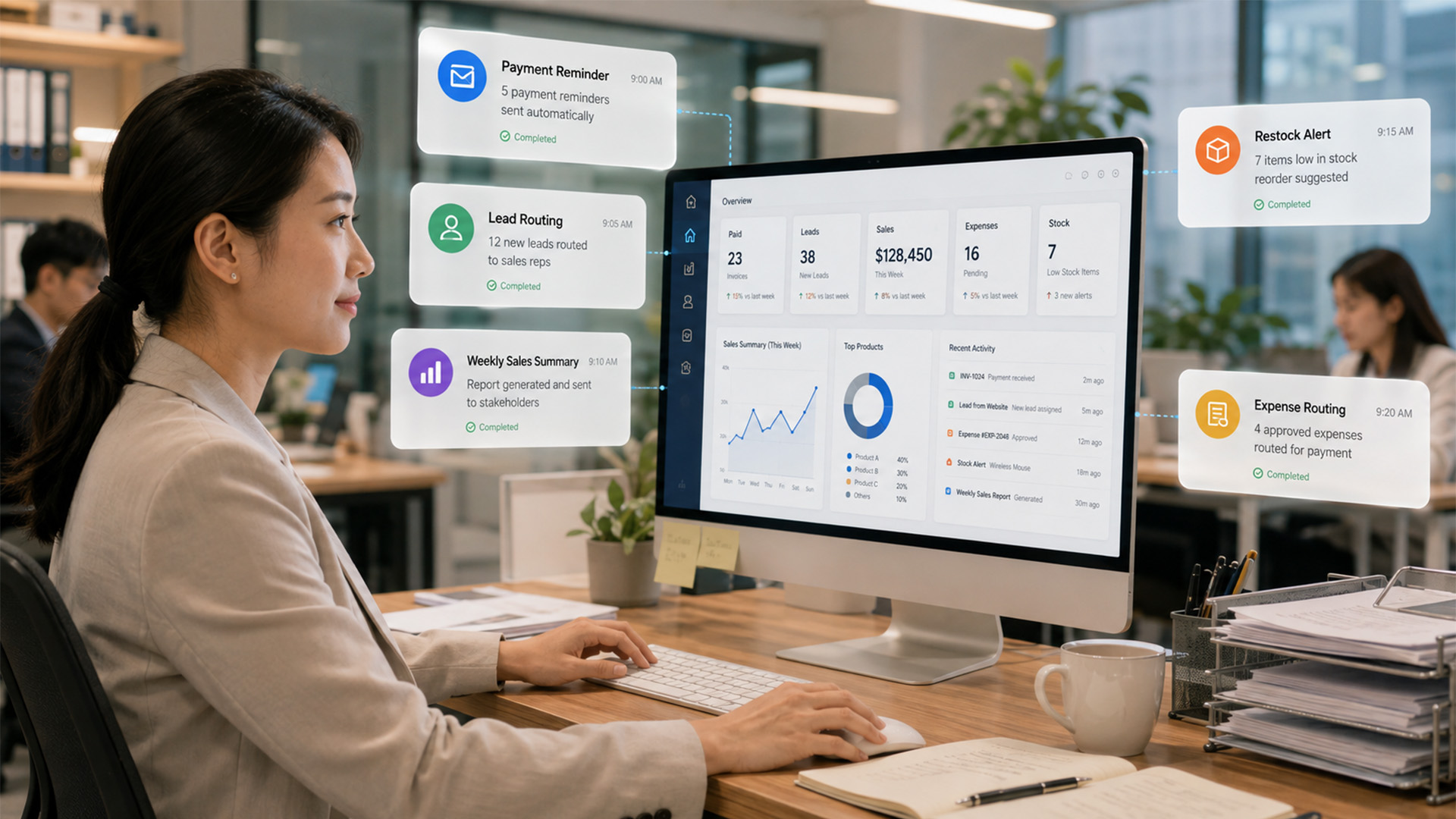
Automation earns its keep on tasks that are repetitive, well-understood, and don’t need judgement. A few examples that show up constantly in small and mid-sized businesses:
- Sending a payment reminder automatically three days before an invoice is due, every time, without anyone having to remember.
- Routing a new lead into the right follow-up sequence based on which form they filled out.
- Generating a weekly sales summary from data that’s already sitting in a POS or accounting system.
- Triggering a restock alert the moment inventory crosses a set threshold.
- Moving an approved expense claim into the finance queue without a manager manually forwarding it.
None of these need a system to “think”. They need a system to do the same correct thing, reliably, every single time. That’s automation’s job, and it does it well.
Real Use Cases for AI Agents
Agents earn their keep where the situation changes each time and a fixed script would break down. A few honest examples:
- A customer support conversation where the question could be about stock, delivery, a return, or something the business has never been asked before, and the right response depends on the specific details.
- A research task that requires gathering information from several places, comparing it, and deciding what actually matters before producing an answer.
- A troubleshooting flow where the first attempted fix might not work, and the system needs to try something else instead of stopping.
This is also where honesty matters most, because a lot of what gets sold as an “AI agent” is closer to automation with a chat interface on top. A genuinely agentic customer chatbot doesn’t just match keywords to scripted replies. It reads the actual question, reasons using the business’s real information, and decides how to respond or where to route the conversation. Synqro’s own AI Chatbot works this way. It’s trained only on a business’s real stock, hours, and policies, so it reasons from accurate information instead of guessing, and it routes conversations to WhatsApp or a booking link once a human handoff makes more sense. That combination, real data plus a genuine decision about what to do next, is what actually separates an agent from a scripted bot wearing an agent label.
What Happens If You Choose the Wrong AI Solution?
Choosing between AI automation and AI agents isn’t just a technical decision. The wrong choice can increase costs, create unnecessary complexity, or leave your team with a system that doesn’t actually solve the problem.
There are two common mistakes businesses make:
1. Using an AI Agent for a Simple, Repetitive Task
If a task follows the same steps every time, you don’t need an AI agent to figure it out.
For example, sending invoice reminders, generating scheduled reports, or moving new leads into a follow-up sequence can usually be handled with straightforward automation.
Using an agent for these tasks can mean:
- Higher running costs
- More complexity to set up and manage
- Less predictable results
- More AI processing than the task actually requires
If the process is predictable, automation is usually the better choice.
2. Using Automation for a Task That Needs Decision-Making
The opposite mistake can be even more frustrating.
Imagine using a scripted chatbot to answer customer questions when every conversation is different. It might handle common questions well but struggle when a customer asks something outside the predefined flow.
This can lead to:
- Repetitive or irrelevant responses
- More conversations being handed to employees
- Poor customer experiences
- Missed sales opportunities
- A system that looks intelligent but isn’t actually making decisions
If the task changes based on the situation, an AI agent may be the better fit.
How to Choose Between AI Automation and AI Agents
The easiest way to decide is to look at the task itself rather than the technology.
Ask these five questions:
1. Does the task follow the same steps every time?
Yes → AI automation
If the process is predictable and the sequence is already known, automation can handle it efficiently.
No → Consider an AI agent
If the steps change depending on the situation, an agent may be more appropriate.
2. Does the system need to make decisions?
If the system simply needs to follow rules such as “if this happens, do that”, automation is usually enough.
If it needs to evaluate information and decide what to do next, an AI agent is a better fit.
3. What happens when something unexpected occurs?
If an unexpected situation should stop the process and involve a human, automation can work well.
If the system needs to investigate the problem, try another approach, or adapt its response, an agent is more suitable.
4. How important is predictability?
For tasks where consistency matters more than flexibility (such as financial workflows, scheduled reports, or routine notifications) automation has a clear advantage.
For tasks where every situation can be different (such as customer conversations, research, or troubleshooting), some variation may be necessary, making agents more useful.
5. Could the task use both?
Often, the answer is yes.
A business might use automation to capture a lead, update the CRM, and send a notification. An AI agent can then handle the conversation with that lead, answer questions, understand their needs, and decide when to involve a human.
This is where AI automation and AI agents work best together:
Automation handles the predictable workflow.
AI agents handle the decisions and conversations within it.
And for many businesses, the best solution isn’t choosing one over the other. It’s using automation and AI agents together, with each handling the type of work it is designed to do best.
Where Businesses Are Actually At Right Now
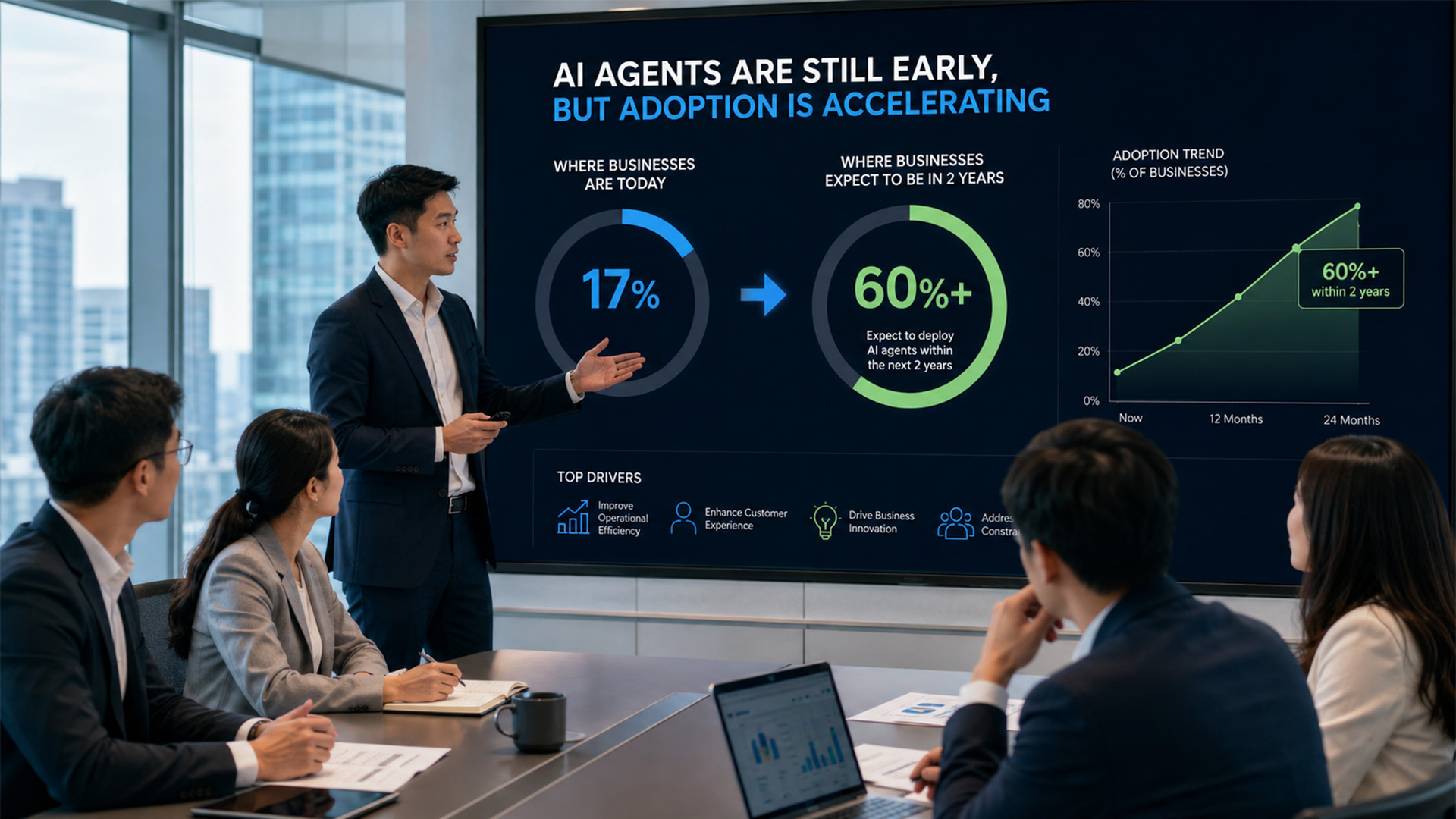
It’s worth knowing that most organisations, even large ones with dedicated technical teams, are still early in this shift. According to Gartner’s 2026 CIO and Technology Executive Survey, only 17% of organisations have deployed AI agents so far, though more than 60% expect to within the next two years.
Interestingly, smaller businesses aren’t necessarily behind here. A growing share of that adoption is happening through ready-built tools rather than custom-engineered systems, which is exactly why an SME doesn’t need an in-house AI team to use a genuine agent well. The businesses struggling most tend to be the ones trying to build an agent from scratch without a clear reason, not the ones adopting a purpose-built tool for a specific job. If you’re a small business that hasn’t fully sorted out automation from agents yet, you’re not behind. Most of the market is figuring this out at the same time you are.
Conclusion
The AI automation vs AI agents debate isn’t really a debate once the jargon is stripped away. One follows a recipe. One acts more like a chef working from a goal. Most businesses don’t need to pick a side. They need to correctly sort their own tasks into the pile that wants a fixed process and the pile that wants real judgement, then use the right kind of tool for each. Get that sorting right, and the technology stops being confusing and starts being useful. If your business needs the reliable, rule-based side of this equation, Synqro’s AI Workflow Automation handles exactly that. If it’s the judgement-and-conversation side you’re missing, the AI Chatbot is built to reason from your real business data instead of guessing. You can also browse the Synqro blog for more guides like this one.
Frequently Asked Questions
1. Is a chatbot always an AI agent?
No. Many chatbots are automated with a chat interface, matching keywords to pre-written replies. A genuine AI agent reasons from real information and can handle a question it wasn’t explicitly scripted for.
2. Which is cheaper to run, automation or an AI agent?
Automation, generally. It follows a known path without needing to reason through options, which makes it both cheaper and more predictable to operate than an agent handling open-ended tasks.
3. Can automation and AI agents work together in the same business?
Yes, and for most small businesses that’s the realistic setup. Automation handles the repetitive, predictable tasks while an agent handles the ones that genuinely need judgment or conversation.
4. How do I know if a tool marketed as an “AI agent” is actually one?
Ask what happens when something unexpected occurs. If the tool needs a human to step in and it just stalls, it’s likely automation with a different label. If it adapts and keeps working toward the goal, it’s closer to a genuine agent.
5. Is it risky for a small business to use an AI agent?
It depends on what the agent is trained on. An agent working from a business’s real data with clear boundaries is generally safe. One using generic, untrained knowledge to answer specific business questions can give wrong answers confidently, which is a real risk worth checking for.

