

AI in Retail: What It Actually Means for a Shop Owner (Not a Tech Company)
Key Takeaway
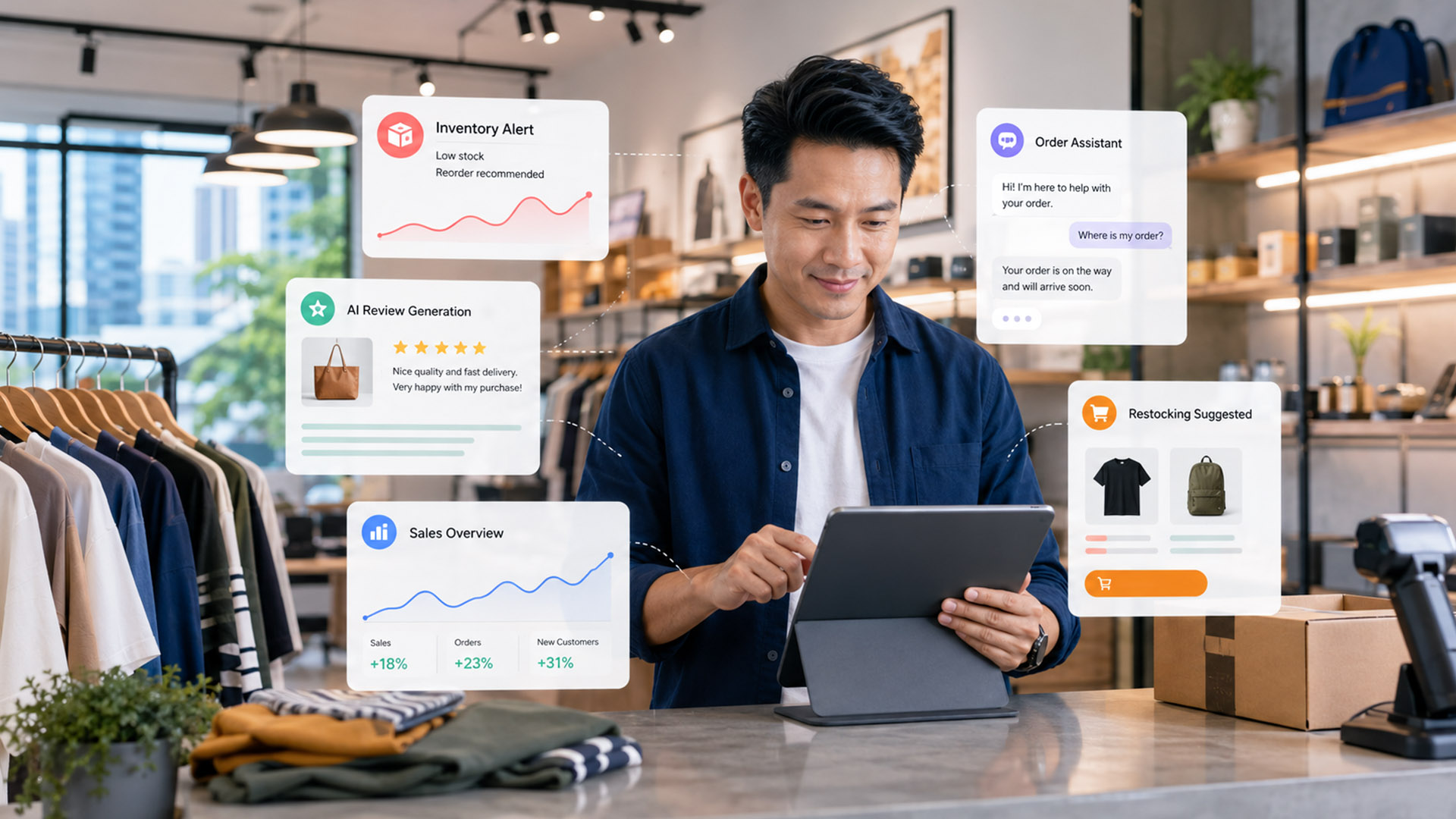
- AI in retail today means practical, everyday tools like inventory alerts, review generators, and order chatbots, not robots or self-checkout screens.
- Retailers in Malaysia and Singapore are already saving hours a week on reporting, restocking, and review collection using AI.
- You don’t need a developer or an IT department to start. Most retail AI tools go live in one to four weeks.
- Real examples include automated Google review requests, WhatsApp order bots, sales dashboards, restock reminders, and loyalty tracking.
- Starting with one process, not five, is what actually makes AI pay off for a small shop.
Picture a Tuesday night. The shop is closed, and you’re still on your laptop trying to figure out why last week’s bestseller is out of stock again. You’re checking three different spreadsheets and a WhatsApp thread with your supplier, hoping the numbers line up before tomorrow’s delivery.
That’s the moment most shop owners start thinking about AI in retail. They realise that in 2026, relying on manual stock counts and spreadsheets simply isn’t sustainable anymore.
The good news is that AI in retail rarely looks like what you’d expect. It’s not a robot walking the aisles or a self-checkout kiosk. For most SMEs, it’s software quietly doing the boring parts of the job so you don’t have to. This article walks through what that actually looks like, with real examples pulled from how small and mid-sized retailers in Malaysia and Singapore are using it right now.
What Is AI in Retail, Really?

AI in retail means using software that can read your sales, stock, and customer data, then act on it or explain it in plain language. Instead of you manually spotting a slow-moving product, the system flags it. Instead of you drafting a review request by hand, a chatbot sends one after every purchase. It’s automation with a bit of judgement built in, not a replacement for you running the shop. The tools don’t decide your strategy. They handle the repetitive work so you have time left to actually think about strategy.
Real Examples: How Retail Shops Are Actually Using AI Right Now
These aren’t hypothetical use cases. They’re what small and mid-sized retailers across Malaysia and Singapore are doing today, often without a single developer on staff.
Automated Sales and Inventory Reporting
Instead of pulling numbers from your POS and spreadsheets every Sunday night, an AI reporting tool connects to your existing sales and inventory data and turns it into a plain-language summary. It flags which SKUs are trending, which are sitting dead on the shelf, and when you’re likely to run out of a bestseller before it actually happens.
Take a mid-sized fashion boutique with two outlets. Before automating reporting, the owner spent close to three hours every Monday morning manually combining sales data from both stores into one spreadsheet. With an AI reporting dashboard connected to both tills, that same summary now takes fifteen minutes to read, and it comes with a note flagging that one size is consistently selling out three days before restock.
Review Collection That Runs Itself
A customer pays, scans a QR code at the counter, and answers two quick prompts. Within seconds, a genuine Google review is posted. If the experience was actually poor, the feedback routes to the owner privately instead of landing on the public profile, which protects the shop’s rating while still surfacing real complaints.
A neighbourhood pharmacy used this after struggling to grow its Google reviews past a dozen for over a year. Within three months of putting a QR code at the counter, the review count passed eighty, and the shop’s local search ranking moved up noticeably for “pharmacy near me” searches in its area.
A Chatbot That Knows Your Actual Stock and Hours
Rather than a generic bot that makes things up, a chatbot trained only on your business answers questions like “Are you open on Sunday?” or “Do you have this in size M?” correctly, in Bahasa Malaysia, English, or Mandarin. It then routes the customer to WhatsApp or a booking link when it’s time to close the sale.
An electronics shop selling mobile accessories used to lose sales overnight because customers messaged after closing hours and moved on to a competitor before staff replied the next morning. After adding a trained chatbot, roughly a third of after-hours enquiries converted into next-day pickups, simply because the customer got an accurate answer immediately instead of silence.
Restock and Reorder Reminders
Workflow automation watches your stock levels and pings you, or your supplier directly, before you sell out of a key item. The same kind of automation can send payment reminders and generate invoices without you touching Excel.
A grocery mini-mart chain with four outlets used to run out of popular snack items almost weekly because reordering depended on staff noticing low stock during a shift. Automated restock alerts tied to actual sales velocity cut out-of-stock incidents on top sellers by more than half within the first two months.
Loyalty Tracking Without a Punch Card
A digital membership app tracks points, stamps, and repeat visits automatically, so you can see who your regulars actually are instead of guessing. Customers add it to their phone home screen through a link or QR code, with no app store download required.
A café chain that previously ran a paper stamp card switched to a digital version and found that customers who joined the loyalty programme visited nearly twice as often within the first quarter, largely because the shop could now send a simple reminder when a customer hadn’t visited in a while.
You Don’t Need a Developer to Start
This is where most shop owners hesitate. AI sounds like something built for tech companies with engineering teams, not a shop with five staff and one POS system.
In practice, that gap has closed fast. Tools built specifically for SMEs now connect directly to the systems you already use. A chatbot can go live in one to two weeks. A branded loyalty app can launch in around fourteen days. Workflow automation for leads, invoicing, or reminders typically takes two to four weeks across a short discovery, build, and launch process. You’re not hiring anyone. You’re plugging in a tool that someone else built and maintains for you.
This matters because retail is genuinely leading the pack on AI adoption in this region. A Deloitte Southeast Asia study across six Asia-Pacific markets found that more than three quarters of SMEs already use at least one AI-enabled digital tool, and 80% say it helps cut the cost of doing business. Retail isn’t behind here. It’s often ahead of other sectors precisely because customer-facing tasks like reviews, chat, and reporting are so repetitive and easy to automate well.
What This Looks Like Across Different Types of Retail

AI in retail doesn’t apply the same way to every shop. What a fashion boutique needs is different from what a pharmacy or a hardware store needs, even though the underlying tools overlap.
Fashion and apparel retailers usually get the most value from inventory reporting and size-level demand tracking, since stock issues tend to be about specific sizes and colours selling faster than others, not just total volume.
Food and beverage shops, including cafés and casual dining, tend to lean hardest on review automation and loyalty tracking, since repeat visits and public reputation drive most of their growth.
Pharmacies and health retailers benefit most from a trained chatbot that can accurately answer stock and availability questions, since customers frequently ask before visiting in person and expect a precise answer, not a vague one.
Electronics and accessories shops see the clearest wins from chatbots and workflow automation, because purchase decisions often happen after hours, and a fast, accurate reply is often the difference between a sale and a lost customer.
Grocery stores and mini-marts typically start with restock automation first, since running out of fast-moving items is the most direct hit to daily revenue, more so than reviews or loyalty in the early stages.
The common thread is that none of these shops needed every tool at once. Each one started with whichever problem was costing them the most time or the most sales, then expanded from there.
Where Retail Owners Go Wrong With AI
A few patterns show up again and again when AI in retail doesn’t work out the way a shop owner hoped.
The first is buying a generic chatbot that wasn’t trained on the actual business. It ends up guessing at answers, and guessing about your opening hours or return policy is worse than not having a bot at all. Customers notice quickly when a bot doesn’t actually know the shop.
The second is trying to automate everything in one go: reporting, reviews, chat, and loyalty, all at once. That’s a lot of change for a small team to absorb in a single month, and staff often revert to old habits when too many new systems launch together. Most successful rollouts start with one problem, like slow review growth or messy stock reports, get it working well, and add the next tool a few weeks later.
The third is expecting AI to replace judgement entirely. These tools are built to remove the repetitive work, not the decisions that need a human who actually knows the shop, the customers, and the neighbourhood.
The fourth, and probably the most common, is picking a tool based on price alone without checking whether it actually connects to the systems already in use. A cheap tool that doesn’t integrate with your POS or your existing WhatsApp Business number often ends up creating more manual work, not less.
How to Choose Your First AI Tool
If you’re not sure where to start, work backwards from whatever task already eats the most of your time or costs you the most sales. A few questions help narrow it down quickly.
Are you spending hours every week compiling reports by hand? Start with reporting. Are your Google reviews stuck below where they should be for a shop your size? Start with review automation. Are you losing customers who message after hours and never get a reply? Start with a chatbot. Are you running out of stock on your bestsellers because nobody notices in time? Start with workflow automation for restocking.
Pick one. Get it running well for four to six weeks. Then look at whether the next biggest time sink is worth solving the same way. Shops that build AI adoption this way tend to stick with it, because each new tool proves its value before the next one gets added.
What AI in Retail Actually Costs

Cost is usually the first question after “How does this work?”, and it’s a fair one. Most retail AI tools built for SMEs run on a monthly subscription rather than a large upfront project fee, which is a deliberate difference from the enterprise software this category grew out of. That structure exists precisely because SME budgets can’t absorb a six-figure implementation the way a large retail chain can.
The more useful way to think about cost isn’t the subscription fee on its own, but what it replaces. A reporting tool that saves three hours a week is replacing roughly twelve hours a month of manual work, time an owner could spend on customers, buying, or simply closing the shop earlier. A review tool that lifts a shop from a dozen reviews to eighty is replacing months of inconsistent, ad hoc asking that rarely worked anyway. Framed that way, the real comparison isn’t “free versus paid”. It’s manual time and lost sales versus a predictable monthly cost.
Most SME-focused providers, including Synqro, scope pricing around which tool and how many locations are involved, rather than a flat enterprise rate. It’s worth asking directly what a specific setup would cost before assuming AI in retail is out of budget, since the answer is often different from what owners expect going in.
Is AI in Retail Worth It for a Small Shop?
Yes, if you start with one clear problem. AI in retail pays off fastest when it removes a specific weekly headache, like manual stock counts, slow review growth, or missed customer messages. Shops that try to automate everything at once tend to stall. Shops that fix one process first usually see the time savings within weeks, not months.
Frequently Asked Questions
Is AI in retail only for big chains with IT teams?
No. Most tools built for SMEs are designed to run without a developer or in-house IT team. Setup is typically handled by the provider, and many retail tools go live within one to four weeks of signing up.
What’s the cheapest way to start using AI in my shop?
Automated review collection and basic reporting dashboards are usually the lowest-cost entry points. Both address problems every shop already has, without touching your existing POS or systems in a major way.
Will an AI chatbot give my customers wrong information?
Only if it’s trained on generic data instead of your business. A chatbot trained specifically on your stock, hours, and policies won’t invent answers the way a general-purpose AI tool sometimes does.
How long does it take to see results from AI in retail?
Reporting and review tools often show visible results within the first two to four weeks. Workflow automation and loyalty apps typically take a bit longer, closer to two to three months, as customer habits adjust to the new system.
Do I need to change my POS system to use AI tools?
Usually not. Most AI reporting, chatbot, and workflow tools are designed to connect to the systems you already use rather than replace them, which is part of why setup tends to be fast.
How much should a small retail shop budget for AI tools?
Most SME-focused AI tools run on a monthly subscription rather than a large upfront project cost. Pricing usually depends on which tool and how many outlets are involved, so it’s worth asking for a direct quote rather than assuming it’s out of reach.
AI in retail isn’t about turning your shop into a tech company. It’s about giving yourself back the hours you currently spend on manual reports, chasing reviews, and reordering stock by memory. The shops seeing real results didn’t overhaul everything overnight. They picked one slow, repetitive task, automated it properly, and built from there once it was working. Whether that starting point is a fashion boutique untangling size-level stock issues or a mini-mart tired of running out of snacks, the pattern holds across every type of retail covered here. If you’re not sure where to start, look at whatever task eats the most of your evening after closing. That’s usually the right place to begin. You can see how Synqro’s AI Reporting Dashboard or AI Chatbot handle exactly this for retail businesses like yours, or browse the Synqro blog for more practical AI breakdowns.

