

The Complete Guide to AI Chatbots for Customer Service in 2026
Key Takeaway
- AI chatbots for customer service have moved past scripted FAQ bots. In 2026, the useful ones read a real question and answer it from a business’s actual information.
- Customers care more about getting a correct answer than getting a fast one. Accuracy beats speed by a wide margin in recent research.
- A chatbot trained only on generic knowledge will eventually give a confident, wrong answer, which does more damage than no chatbot at all.
- The best customer service chatbots for small businesses don’t try to replace a person. They handle the repetitive questions and hand off cleanly when a human is genuinely needed.
- Setup, cost, and what to check before buying matter more than which AI model powers the bot underneath.
Introduction
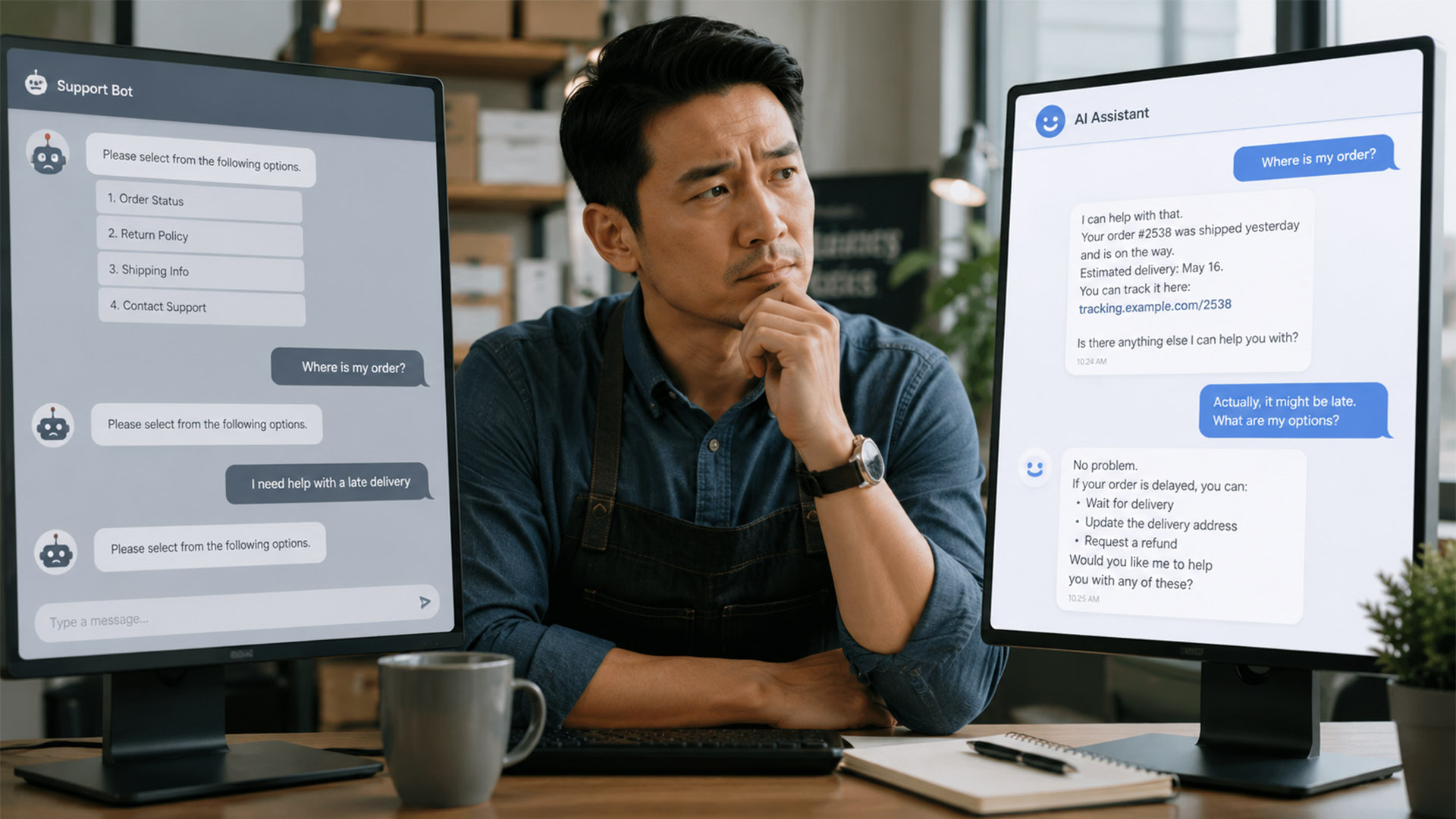
Somewhere between “type your question here” boxes that only understood three phrases and today’s chatbots that can actually hold a real conversation, a lot changed. But a lot of confusion came with it too. Every software vendor now calls their product an “AI chatbot”, whether it genuinely understands a customer’s question or just matches keywords to a script written two years ago.
This guide cuts through that. It’s written for business owners deciding whether a customer service chatbot is worth setting up, not for developers building one from scratch. No deep dives into the underlying technology, no enterprise case studies from companies with call centres the size of a small country. Just what these tools actually do, where they genuinely help, where they tend to go wrong, and what to check before you commit to one.
What Is an AI Chatbot for Customer Service?
An AI chatbot for customer service is software that understands what a customer is trying to accomplish, finds the right information, and responds without requiring a person to type the answer.
The important part is intent.
A customer might ask, “Do you have this in blue?”, “Is the blue one available?”, or “Can I get this in navy?” The words are different, but the intent is the same: they want to know whether a specific product is available in a particular colour.
An intent-based AI chatbot recognises that underlying need instead of simply matching keywords to a pre-written response. It then uses the business’s real information, such as products, services, stock, pricing, policies, opening hours, or booking availability, to help solve the customer’s problem.
For a great customer experience, your chatbot should focus on solving customer questions and problems first, not trying to sell your products or services. If a customer needs help choosing a product, the chatbot can answer their questions and explain the relevant options. If booking a service is the natural next step, it can guide them there. If they simply need an answer, it gives them the answer and stops. The product or service becomes part of the solution, not an interruption to the conversation.
How an Intent-Based AI Chatbot Actually Works
A customer doesn’t always tell a chatbot exactly what they want. They describe a problem, ask a question, or give incomplete information. An intent-based chatbot works backwards from that message to understand the customer’s actual need.
For example, imagine a customer says:
“I need something for sensitive skin. What would you recommend?”
The chatbot doesn’t simply look for the word “sensitive” and send a product link. It understands that the customer is looking for a suitable product, checks the business’s available products and relevant information, asks a follow-up question if necessary, and then recommends an appropriate option. If the customer is ready to buy, it can naturally guide them to the product page or checkout. If they aren’t, that’s fine too. The chatbot has still done its job: it helped the customer.
Intent First, Not Keyword Matching
Customers rarely speak in perfectly structured questions.
They might say:
- “Can I get this tomorrow?”
- “Is there anything similar but cheaper?”
- “I need to book for next Saturday.”
- “My order hasn’t arrived yet.”
- “Which one is better for me?”
An intent-based chatbot looks beyond the exact words to understand what the customer is trying to do: check availability, find an alternative, make a booking, track an order, or get a recommendation.
That makes the conversation feel much more natural than clicking through a menu of predefined options.
Solve the Problem Before Recommending Anything
A customer service chatbot shouldn’t treat every conversation as a sales opportunity.
If someone asks about delivery times, answer the delivery question. If they want to change a booking, help them change it. If they’re comparing two products, help them understand the difference. Once the customer’s need is clear, the chatbot can guide them towards a relevant product or service when it genuinely makes sense. That’s a much more natural path to conversion than repeatedly pushing a “Buy Now” message.
Use Real Business Information
Understanding intent is only half the job. The chatbot also needs accurate information to act on that intent. A good AI chatbot should be connected to the information that actually matters to the business, such as:
- Products and services
- Prices and promotions
- Stock or availability
- Opening hours
- Delivery information
- Booking availability
- Return and cancellation policies
- FAQs and business policies
This means the chatbot can answer based on what is actually true for the business, rather than relying on generic AI knowledge.
Know When to Hand Over to a Human
An AI chatbot shouldn’t try to answer everything. If it can’t find enough information, the customer’s request is sensitive or complicated, or the conversation requires human judgement, the best response is a handoff.
“I’m not sure about that. Let me connect you with someone who can help.” That isn’t a failure. It’s good chatbot design. The goal isn’t to eliminate humans from customer service. It’s to let AI handle the questions it can answer well and bring people in when they add more value.
Accuracy Matters More Than Speed
Instant replies are useful, but speed alone doesn’t make a customer service chatbot good. A fast chatbot that misunderstands the question or gives the wrong information can create more work than it saves. A slightly slower system that understands the customer’s intent and gives an accurate answer is far more valuable.
This is why the quality of an AI chatbot depends on more than the underlying AI model. It also depends on how well the chatbot understands intent, what business information it can access, and what it does when it isn’t confident about an answer. The best customer service chatbots aren’t designed simply to answer more questions. They’re designed to understand the customer, solve the problem, and make the next step easier.
And when that next step happens to be buying a product, booking a service, or contacting the business, the conversion feels like a natural result of good customer service.
What’s Actually Different About Chatbots in 2026
The category has shifted in a few concrete ways worth knowing before you compare options.
Chatbots are increasingly channel-native rather than website-only. A few years ago, “chatbot” almost always meant a widget in the corner of a website. Now, for a lot of small businesses, especially across Malaysia and Singapore, the more useful version lives directly inside WhatsApp, where customers already message the business anyway, rather than expecting them to visit a separate page.
Multilingual support is now closer to a baseline expectation than a premium feature. A chatbot that only replies in English is a real gap in markets where customers move fluidly between Bahasa Malaysia, English, and Mandarin within the same conversation.
Handoff has gotten smarter. Earlier chatbots either answered or dumped the customer into a generic contact form. The better ones now route directly to a specific channel, like WhatsApp or a booking calendar, based on what the customer actually needs, rather than a one-size-fits-all “contact us” dead end.
And the honest gap between “AI-powered” marketing and genuine business training has become more visible. Customers have now had enough bad chatbot experiences that a wrong answer costs more trust than it used to. That’s part of why the accuracy research above matters more in 2026 than it did when chatbots were still a novelty.
AI Chatbot Use Cases for Small and Medium Businesses

Small and medium businesses don’t need an AI chatbot because AI is fashionable. They need one when customer questions are taking up too much of the team’s time, enquiries are going unanswered, or potential customers are being lost simply because nobody is available to respond.
Unlike enterprise use cases built around large banking apps or complex HR systems, the value for a small business is often much simpler: answer the questions customers ask every day, solve basic problems, and help them take the next step.
Here are some of the most practical use cases:
- Answering after-hours questions: A customer might message at 10pm asking whether a product is in stock, whether a service is available, or when the business opens. A chatbot trained on real business information can answer immediately instead of leaving the customer waiting until morning.
- Handling booking and appointment queries: Salons, clinics, consultants, and other service businesses receive constant questions about availability. A chatbot can understand what the customer needs, check or direct them to the appropriate booking information, and help them schedule the next step without staff involvement.
- Handling order and delivery questions: For e-commerce and delivery-based businesses, “Where is my order?” is a repetitive but important question. When connected to the right systems, a chatbot can provide order or delivery information without requiring an employee to manually check and respond.
- Answering common policy questions: Return policies, warranty terms, delivery charges, cancellation rules, and payment options are often repeated throughout the day. An AI chatbot can provide consistent answers based on the business’s actual policies.
- Helping customers choose the right product or service: This is where an intent-based chatbot can do more than simply answer FAQs. It can understand what the customer is looking for, ask relevant questions, use the business’s product or service information, and guide them towards an appropriate option—without turning every conversation into a sales pitch.
- Capturing enquiries when the team isn’t available: Someone asking about pricing, availability, or a service after business hours shouldn’t have to wait until the next day to take the next step. A chatbot can answer what it can, collect the relevant details, and guide the customer towards a booking form, product page, WhatsApp conversation, or human follow-up.
So, Does Your Small Business Actually Need an AI Chatbot?
Not every business does. If your customers rarely ask questions online and your team can easily handle the existing volume, a chatbot may not add much value.
But if the same questions keep appearing, customers expect quick answers, staff spend hours responding to repetitive enquiries, or leads are going cold outside business hours, an AI chatbot can make a meaningful difference.
The key is choosing the right kind of chatbot. A basic bot that matches keywords to scripted replies may save some time, but an intent-based AI chatbot trained on your actual business information can do much more.
It understands what customers are trying to accomplish, helps solve their problem, and guides them to the right next step when appropriate.
For a small business, that’s often the real value of AI. It does not replace your customer service team but gives them a system that handles the routine conversations while they focus on the customers and tasks that genuinely need a human.
Conclusion
An AI chatbot for customer service in 2026 isn’t judged by how fast it replies or how natural it sounds. It’s judged by whether it’s actually right and by what happens the moment it isn’t. A chatbot trained on real business information, with a clean path to a human when it’s genuinely needed, solves a real problem for a small business. One trained on nothing but general knowledge just moves the risk from an unanswered message to a confidently wrong one. If after-hours enquiries or repetitive customer questions are eating into your team’s time, Synqro’s AI Chatbot is built around exactly that problem, trained on your real business information rather than a generic model. You can also browse the Synqro blog for more practical guides like this one.
Frequently Asked Questions

What’s the difference between a chatbot and an AI chatbot?
A basic chatbot follows a fixed script and breaks when a question falls outside it. An AI chatbot reads natural language and can handle varied phrasing, though it still needs to be trained on real business information to answer accurately rather than guess.
Will customers know they’re talking to a chatbot?
Most well-designed chatbots are upfront about being automated, which research shows customers generally accept, provided the bot is accurate and hands off to a human when needed. The issue customers react badly to isn’t automation itself; it’s getting a wrong or unhelpful answer.
Can a chatbot handle multiple languages?
Yes, well-built chatbots for customer service typically handle several languages depending on the customer, which matters in markets like Malaysia and Singapore, where a single business often serves customers across Bahasa Malaysia, English, and Mandarin.
How long does it take to set up a customer service chatbot?
Tools built specifically for small businesses are typically trained and live within one to two weeks. Larger, more customised enterprise platforms usually take considerably longer.
Does a chatbot replace human customer service staff?
Not typically. It removes the repetitive, predictable questions from a team’s workload, freeing staff to handle situations that genuinely need a person, rather than replacing the team outright.

