

How Retail Automation Helps Scale Your Business Faster
Key Takeaways
- Retail automation helps a business scale by removing the operational ceiling that shows up long before revenue growth actually stalls.
- Most retail businesses don’t fail to grow because of weak demand. They stall because processes that worked at one outlet break down at three.
- Automation lets a shop add outlets, staff, or order volume without a proportional increase in manual admin work.
- Owners who automate before they scale avoid rebuilding their systems mid-growth, which is far more disruptive than building them early.
- Growth data from an automated system gives an owner a much clearer picture of where to expand next than gut instinct alone.
Most retail owners think about growth in terms of sales: more customers, more outlets, more revenue. Few think about growth in terms of what actually breaks first when a business expands. It’s rarely in demand. It’s almost always the operations behind the demand, the reordering, the reporting, and the customer follow-ups – all the things one person or one small team could keep on top of manually at a single outlet but can’t once the business is bigger.
This is the part retail automation actually solves. Not “efficiency” in the abstract sense, but the specific operational ceiling that stops a business from scaling even when the sales opportunity is clearly there. This article looks at that ceiling directly: where it shows up, why automation is what removes it, and how to think about sequencing automation ahead of growth instead of scrambling to catch up after it.
The Real Bottleneck to Growth Isn’t Sales

It’s tempting to assume that scaling a retail business is mostly a marketing problem: get more customers in the door, and growth follows. In practice, the businesses that actually stall while scaling usually have no shortage of demand. What they run out of is the operational capacity to serve that demand consistently.
Research on small business bottlenecks backs this up directly. A Hatch Tribe analysis citing Databox research found that roughly 58% of business bottlenecks come from inefficiency in how work gets done, not simply from having too much work to handle. In other words, most growth-stage businesses aren’t overwhelmed by volume. They’re being slowed down by systems that were never built to handle more than they were originally designed for.
For a retail business, that shows up in very specific, familiar ways. Reordering that depended on one staff member noticing low stock starts missing items once there’s a second outlet to watch. A founder who used to answer every WhatsApp message personally can’t keep doing that once enquiry volume triples. A weekly sales report that took an hour to compile from one till takes half a day once there are four tills across different locations feeding into it.
Why Manual Processes Work Until They Suddenly Don’t
There’s a reason this problem tends to appear all at once rather than gradually. Manual processes rely heavily on a small number of people holding a lot of operational knowledge in their heads. At one outlet with a handful of staff, that’s manageable. Everyone roughly knows how things work, and the owner can personally catch most mistakes before they matter.
The moment a second location opens, or a new hire joins who wasn’t there when the informal system was built, that knowledge doesn’t transfer cleanly. Processes that were never written down get done differently in different places. Small inconsistencies that didn’t matter at a single outlet start compounding into real problems: one location’s reorder threshold is different from another’s, one team answers customer messages faster than another, and nobody notices until a customer complains or a shelf sits empty for a week.
Automation solves this specific problem because it turns an informal, person-dependent process into a documented, consistent one. The rule for when to reorder, how to respond to a review, or when to follow up with a lapsed customer becomes the same rule everywhere, run by the system rather than by whoever happens to be on shift that day.
Scaling Outlets Without Scaling Headcount One-for-One
One of the clearest signs a retail business is ready to grow, but not ready operationally, is when every new outlet requires roughly the same increase in back-office headcount as the last one. That’s not scaling. That’s just repeating the same cost structure at a larger size, and it puts a hard ceiling on how profitable growth actually is.
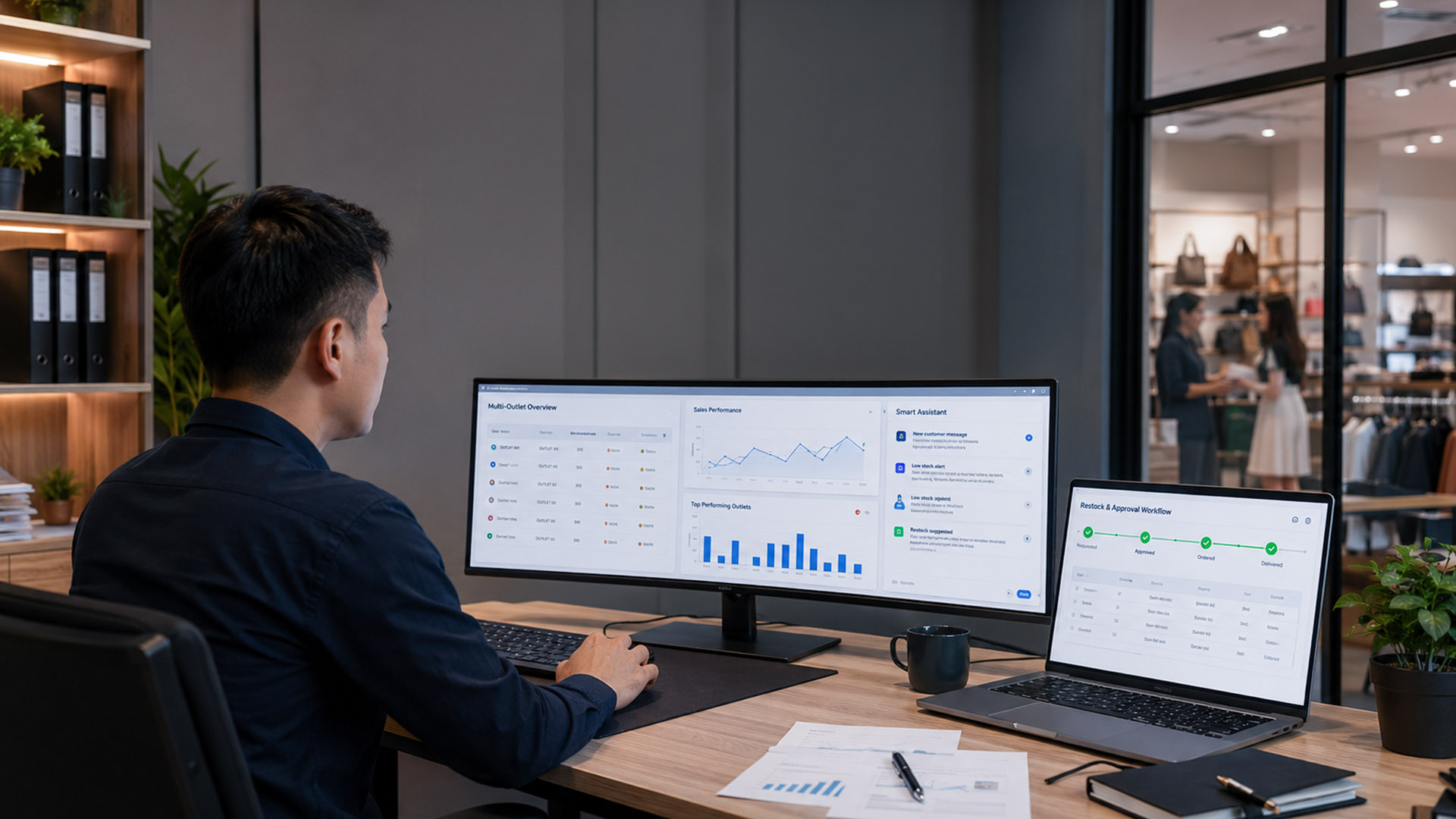
Automated workflows change that relationship. A reporting system that already pulls data from one outlet can usually absorb a second or third outlet’s data without needing a second person to compile it. A chatbot answering customer questions for one location can typically handle questions for several, provided it’s trained on each location’s specific details. A workflow tool routing approvals or restock alerts doesn’t need more staff to cover a fourth outlet the way a fully manual process would.
This is the difference between growth that adds proportional cost and growth that adds mostly revenue. It’s also usually the single biggest factor in whether a second or third outlet is actually more profitable than the first, or just a bigger, more stressful version of it.
Consistency Is What Makes Multi-Location Growth Actually Work
Customers don’t experience a business as a single entity when it has multiple outlets. They experience whichever location they walked into that day, and they expect it to feel like the same business every time. Inconsistent service, inconsistent stock availability, or inconsistent response times across locations quietly erode the trust that took the first outlet years to build.
Automated processes are, almost by definition, consistent. A review request that goes out the same way after every purchase, at every outlet, produces a more even customer experience than one that depends on which staff member happened to remember to ask. A chatbot trained once on accurate business information gives the same correct answer regardless of which location a customer is asking about. This consistency becomes more valuable, not less, the more locations a business adds, since it’s the thing preventing growth from diluting the brand a shop has already built.
Growth Data You Can Actually Trust
Expansion decisions, whether that’s a new outlet, a new product line, or extended hours, are only as good as the data behind them. Manual reporting tends to lag behind reality by days or weeks, and it often gets simplified or summarised inconsistently depending on who compiled it that particular week.
Automated reporting removes that lag and that inconsistency. An owner deciding whether a second location is viable can look at real, up-to-date sales and demand patterns from the first, rather than a rough impression pieced together from memory and a few spreadsheets. This matters more at the point of scaling than at almost any other stage of the business, because expansion decisions are expensive to get wrong, and the cost of a bad location or a mistimed launch is much higher than the cost of getting reliable data before deciding.
Automate Before You Scale, Not After

There’s a strong temptation to wait until growth is already underway before investing in automation, on the logic that it’s not worth the cost until the business is bigger. In practice, this usually backfires. Building automation into a business before it scales is far less disruptive than trying to retrofit it onto a business that’s already strained.
A workflow, reporting system, or customer communication process built for one outlet from the start tends to extend naturally to a second and third. The same system built reactively, after chaos has already set in across multiple locations, usually requires untangling a mess of inconsistent manual habits first. Retail businesses that automate a process while it’s still simple, even before they strictly need to, generally have an easier time scaling than those that wait until the strain forces the decision.
What This Looks Like in Practice
Putting this together, a retail business preparing to scale is usually looking at some combination of the following: workflow automation to keep reordering, approvals, and communication consistent as more locations or higher volume come online; automated reporting that gives an accurate, current view across every outlet instead of a delayed, manually stitched-together one; a chatbot that can handle rising customer enquiry volume without needing headcount to grow at the same rate; automated review and loyalty tracking that keeps the customer experience consistent as new locations open; and a foundation built early enough that it doesn’t need to be rebuilt mid-growth.
None of these require a large team to run. They’re built specifically so a small operations team can manage a business that’s meaningfully bigger than it used to be, without each new location adding a proportional amount of manual work.
Does Retail Automation Actually Help a Business Grow Faster?
Yes, though not by generating more demand directly. It works by removing the operational bottlenecks, inconsistent processes, delayed reporting, and person-dependent knowledge, that otherwise cap how much a retail business can grow before things start breaking. Businesses that automate early tend to scale with far less friction than those that wait.
Frequently Asked Questions
Does retail automation help a business get more customers?
Not directly. Its main effect on growth is removing the operational limits, like inconsistent processes and slow reporting, that stop a business from serving more customers reliably once demand increases.
At what stage should a retail business start automating for growth?
Ideally before opening a second outlet, not after. Automating a single, simple process is far easier than untangling inconsistent manual habits across multiple locations later.
Does automation reduce the need for staff as a business scales?
It reduces the need for headcount to grow at the same rate as the business, rather than eliminating roles outright. The goal is avoiding a one-for-one increase in admin work per new outlet, not reducing the team that serves customers.
How does automation affect consistency across multiple locations?
Automated processes run the same way at every location by default, which tends to produce a more consistent customer experience than manual processes that vary depending on staff and location.
Is it too early to automate a single-outlet business that isn’t scaling yet?
Not necessarily. Building the process while it’s still simple, even before growth is imminent, tends to be far less disruptive than adding automation reactively once a business is already stretched across multiple locations.
Scaling a retail business rarely fails because of weak demand. It fails because the systems behind the scenes weren’t built to handle more than one outlet’s worth of manual attention. Retail automation addresses that directly, not by making a shop busier, but by making sure growth doesn’t multiply the operational strain along with it. If you’re planning to add a location, a product line, or simply more volume than your current processes can comfortably handle, it’s worth automating the operational side first. Synqro’s AI Workflow Automation and AI Reporting Dashboard are built specifically for that stage, and tools like the AI Chatbot and Membership App help keep the customer experience consistent as you grow. You can also browse the Synqro blog for more on preparing a retail business to scale.

